TechCrunching The Enterprise: TechCrunchIT
Michael Arrington
47 comments »
 We just launched TechCrunchIT
 , our newest property, with editors Steve Gillmor and Nik Cubrilovic. The site is focused on the enterprise tech space - all the software, technologies, standards, platforms, etc. that help companies do their thing, and form the building blocks of the products we feature on TechCrunch, MobileCrunch and our other blogs.
TCIT will be a lot like TechCrunch in editorial and content style - a range of enterprise-related news and analysis including applications, open standards, platforms, cloud computing, microenterprises, customer experience, legacy enterprise, social media, information management and software among other subjects. They aim to promote an understanding of emerging and existing enterprise technologies and products and to analyze their commercial, social, and consumer impact.
Make sense? If it’s not clear where the line is between TechCrunch and TechCrunchIT, perhaps my muffler analogy will help. A frequent debate on the Gillmor Gang is over the importance, or at least the interestingness, of end user/consumer products (think YouTube) v. the technologies that allow those products to exist (in YouTube’s case, Adobe Flash). I personally think the YouTube’s of the world are more interesting, and I refer to those products as “Ferarris.” All the technology that goes into making those Ferarris I refer to as “mufflers” (the enterprise guys hate that, which is why I keep doing it).
Basically, TechCrunchIT is a blog about the mufflers. And Steve and Nik are going to do their best to keep you entertained while reporting every important development in the muffler market.
Quite often there will be cross coverage between the blogs when we think a particular story will interest both sets of readers. Also, Steve and Nik will continue to occasionally write here on TechCrunch. You may even see me hop over to TechCrunchIT once in a while to write a post or two.
We have two terrific sponsors right out of the gate - Microsoft and Sun. Thanks to both of them for believing in us as we get started with TechCrunchIT. There are still a few bugs on the site, so bear with us as the paint dries and everything settles down. But if you hurry over there now, you’ll see some live coverage of the Salesforce/Google event in San Francisco today.

Top 100 Advertisers Shifted $1 Billion To the Web Last Year At The Expense Of TV And Newspapers
Erick Schonfeld
27 comments »
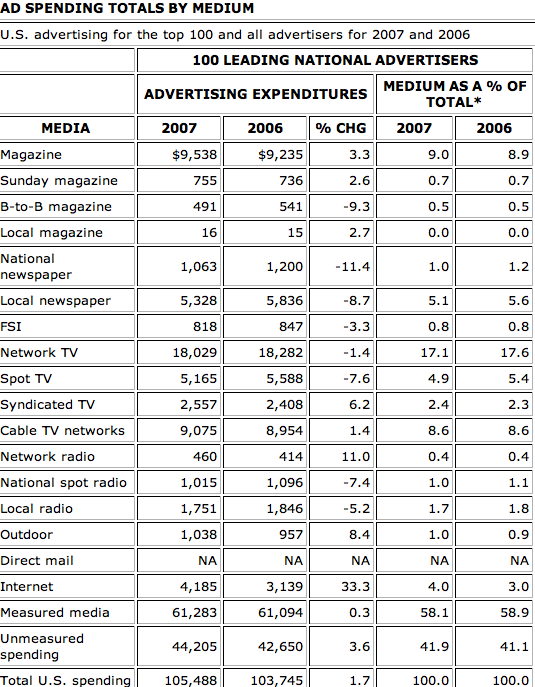
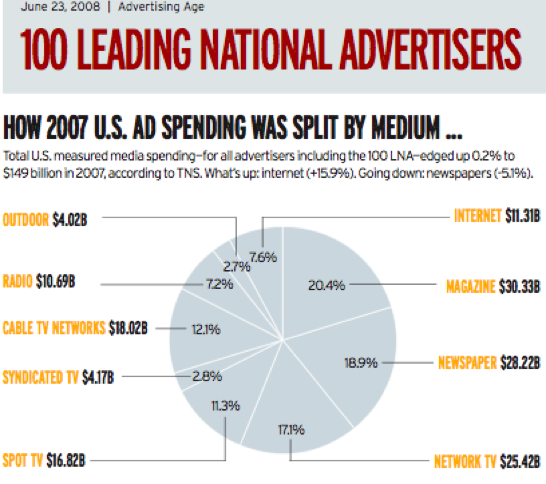
The top 100 advertisers in the U.S., who represent 41 percent of total advertising spending, shifted about $1 billion last year from TV and newspapers to the Web. An analysis from Ad Age shows that overall media spending in “measured” categories (TV, print, radio, Web) by the top 100 advertisers was flat in 2007, with 0.3 percent growth to $61.3 billion. But spending on Web display ads rose 33 percent to $4.2 billion. The article notes:
Put another way, these top-tier marketers increased measured internet spending by $1 billion; slashed newspaper spending by $674 million; and cut TV budgets by $406 million.
This is yet one more piece of evidence that dollars are flowing from traditional media to the Web. The analysis is based on data from TNS Media Intelligence for 2007. TNS only measures display advertising, and not search.
The big question is whether the recession that has already hit some categories of advertising will hit the Web this year. Already, the growth of spending in display advertising slowed overall in the first quarter of 2008. And the Interactive Advertising Bureau showed a slight decline for all Web advertising (including search) to $5.8 billion in the first quarter, from $5.9 billion in the fourth quarter of last year.
Here is a table from Ad Age showing the breakdown in spending for the top 100 advertisers (the $44 billion in “unmeasured spending” includes things like direct marketing, in-store advertising, and other promotions, and is not included in the figures cited above):
Chat With Facebook Friends and Share Flickr Pics or YouTube Vids On Your Phone With Jibe Mobile (Invites)
Erick Schonfeld
18 comments »

There are plenty of ways to upload photos and other content from your phone to the Web. But the premise behind Jibe Mobile is simply to be able to use your phone to share social media already on the Web with your friends, whether they are online or out with their phones. The service is launching today in private beta. We have invites for the first 300 people to sign up here.
 Jibe is a Website, a mobile app, and a Facebook app. It lets you import your Facebook friends as contacts, or invite your own. Once you download Jibe’s mobile app to any Java phone (including ones from Nokia, Motorola, Samsung, and Sony Ericsson), you can text chat with any contact. I tested it on my Blackberry curve and it worked without a hitch.
In addition to the basic IM functionality, Jibe lets you send outs “shouts” (little emoticon-like avatars who say things like “What up Dude?”), share photos from Flickr, videos from YouTube, or stories from RSS news feeds. The shouts come out as both text messages and short audio messages through your phone’s speaker.
CEO and founder Amir Sarhangi says:
We are not a social network. We are really the glue in the middle.
Jibe wants to make it easy to socialize with friends around social media from your phone. For instance, you can browse channels of popular YouTube videos, Flickr photos, or top Yahoo News feeds, all from within the mobile app. You can also search for specific Flickr images or YouTube videos without leaving the app. Once you find something you want to share, you can forward it to a contact with a few clicks.
Jibe will soon add support for more social networks beyond Facebook, such as Bebo and MySpace. And will also support more social media services, such as PhotoBucket. What Jibe doesn’t let you do just yet is upload your own photos or videos from your mobile phone to your favorite social network or social media Website. Other than that, it is a solid app that is off to a good start.
The company was founded in December 2005, and raised $800,000 in angel money last December.
Chictopia Takes On Sugar Inc With “Everybody is Ugly”
Jason Kincaid
37 comments »

Chictopia, a social network focused on fashion, has launched a new online publishing network dubbed “Everybody is Ugly” that aims to take on Sugar Inc’s empire. The network features a number of online magazines directed towards various demographics, including Male Ugly (for men), Coed Ugly (college students), and Brit Ugly (for Europeans).
The company says that each blog will be edited by experienced fashion writers who will also be accessible through Chictopia’s social network. Because each writer’s profile will be made public, readers should be able to selectively choose the articles that correspond best to their styles - something that can be hard to do with the faceless authors found in fashion magazines.
Chictopia’s flagship social networking site, which launched two months ago, allows users to upload their style photos and browse through outfits their peers have shared. There are a number of similar fashion sites on the web, including StyleMob, ShareYourLook, and MyStyleDiary.
The new blogs may be enough to separate Chictopia from these relatively small networks, but the company may be in for a rude (and dare I say, ugly) awakening when it faces off with Sugar Inc, which has over 8 million unique visitors across its blog network every month.
Google’s Android Hits Snags With Mobile Carriers
Erick Schonfeld
28 comments »

Google is finding that launching an entirely new cell phone platform is taking longer than expected. When it first announced its Android mobile operating system, Google said the first Android phones would be available during the second half of this year. Now the mobile carriers that signed up as Android partners are pushing out their launches, with only T-Mobile still trying to get an Android phone out by the fourth quarter of this year. All the other carriers are pushing out their deployments until 2009. Reports the WSJ:
T-Mobile USA expects to deliver an Android-powered phone in the fourth period. But that launch is taking up so much of Google’s attention and resources that Sprint Nextel Corp., which had hoped to launch an Android phone this year, won’t be able to, a person familiar with the matter said.
China Mobile, the largest wireless carrier in the world with nearly 400 million subscriber accounts, had planned to launch an Android phone in the third quarter but it has run into issues that will likely delay the launch until late this year or early 2009, a person familiar with the matter says.
. . . AT&T Inc., the U.S. carrier for the iPhone, is still working with Google to determine if it is feasible to launch an Android phone.
Sprint wants to add its own bells and whistles to its Android service, and the recent management shakeup is not helping matters. China Mobile is having trouble getting Android to work with Chinese characters and integrating it into its existing data services.
By the time Android phones seriously hit the market next year, there will be more than 10 million iPhones and many more Blackberries and other smart phones to contend with. Android holds a lot of promise and is generating a lot of excitement among developers, who are already creating interesting mobile apps for the platform. But without phones in consumer’s hands, it won’t matter how cool Android is.
Getting Android right is immensely important to Google, which faces a huge platform shift as the mobile Web finally starts to take off. It needs to parlay its leading position on the Web today into a leading position on the mobile Web. And it cannot do that alone. The more players involved (carriers, developers, handset manufacturers), the greater the chance for delays or other hiccups. Contrast that with Apple’s approach to the iPhone, where it controls every aspect it can. Which platform will win in the end?
Modeling The Real Market Value Of Social Networks
Michael Arrington
139 comments »
Is MySpace worth $3 billion, or $20 billion? It depends on how you value a user.
It’s time to start comparing the big global social networks on something other than unique visitors and page views. I believe an effective way to value a particular user is based on the average Internet advertising spend per person in the country they live in. The higher the spend, the more value the social network can get out of the user by serving them advertising and other products. That means that, for now, users in a handful of key countries are worth far more in terms of revenue potential than those in the rest of the world.
We’ve begun to build out a model that looks at social network usage by country/region and compares that to available data on total Internet advertising spend in each of those countries. The model is then able to turn an apples-to-oranges comparison into an apples-to-apples comparison. The early results are surprising.
The ultimate financial value of any asset is, ultimately, what the market will pay for it. We have only a few data points to help us: Facebook, Bebo and LinkedIn are worth $15 billion, $850 million and $1 billion, respectively, based on relatively recent valuations (although only Bebo was actually sold completely; Facebook and LinkedIn raised investments at those valuations). The last valuation of MySpace was just $580 million, back in 2005 when it was acquired by News Corp.
Which valuation is most “correct?” It’s hard to say based on the data that’s been available to date, which is mostly just aggregate page view and unique visitor numbers from Comscore and other services. Based on worldwide unique visitors, for example, Facebook recently overtook MySpace to become the “largest” social network.
According to raw worldwide user number, the biggest social networks are Facebook, Myspace, Hi5, Friendster, Orkut and Bebo, in that order. But when you apply the model that we’ve created below, which takes into account where users live, the rankings change substantially. MySpace is by far the most valuable social network based on available data. A competitor like Orkut is worth only 1/20th of MySpace, even though it has nearly 1/4 the number of users.
Properly Ranking Social Networks
 Our model takes Comscore data for available countries and regions. We’ve graphed each of 26 well known social networks with the data we have been able to collect. We’ve then calculated the average advertising spend (estimated by PriceWaterhouseCoopers in a recent report) for each person online in each of those countries. For example, in the U.S., the total 2008 estimated Internet advertising spend is $25.2 billion. We’ve divided that by the number of people online in the U.S. according to Comscore (191 million), to get an average Internet spend per person of $132. View the raw data and calculations here.
The U.S., by the way, is only the 4th most valuable market per Internet user, trailing The UK ($213), Australia ($148) and Denmark ($144).
We’ve then multiplied the average Internet spend per user in each market with the number of unique users each social network has in that market, essentially creating a “weighted average” based on the advertising dollars chasing users. If a social network has more users in the U.S., Japan, the UK, Germany, Australia, and other bigger advertising networks, they will have a higher weighted average valuation.
We believe this model is an effective way to rank various competing social networks. It bumps down networks like Orkut and Friendster who have tens of millions of users in markets with very little advertising spend, and bumps up networks with lots of users in higher value markets.
Based on this model, MySpace is by far the most valuable social network. Second place Facebook has just 75% of the value of MySpace (even though it now has more users), followed by Bebo (26% of MySpace value), Hi5 and Amebio. LinkedIn comes in at no. 11, at 6% of MySpace’s value.
Valuation Ranges
The real-world revenue numbers being reported for the big networks supports this approach to valuation and shows a direct tie between monetization efforts and where a network’s users are. MySpace is estimated to have generated $755 million in revenue over the last year. The (now) larger Facebook, with a far higher percentage of users in less lucrative markets, will generate just $255 million this year:
EMarketer estimates that MySpace will post $755 million in revenue in the fiscal year ending June 30. MySpace would not comment on the estimate. About a third of the revenue is expected to come from the Google ad pact. For the year, Facebook is estimated to earn $265 million in ad revenue.
Since we have three recent data points valuing social networks (Facebook at $15 billion, Bebo at $850 million, LinkedIn at $1 billion), we can start to apply valuation ranges based on the model. Facebook’s 10.2 million value points and $15 billion valuation puts a $1,467 value on each value point. LinkedIn is valued very similarly, at $1,325 per value point. Bebo, with lots of users in the rich UK market, appears to have been undervalued at only $241 per value point.

Based on these three publicly available data points we’ve created value ranges for each of the top 25 worldwide social networks. There is a very wide disparity (MySpace, for example, is worth between $3.3 billion and $20 billion, based on which comparable you look at). But it does yield very interesting data. For example, If Facebook and LinkedIn were valued similarly to Bebo, they would be worth just $2.5 billion and $182 million, respectively, far less than what their investors recently paid for a piece of them.
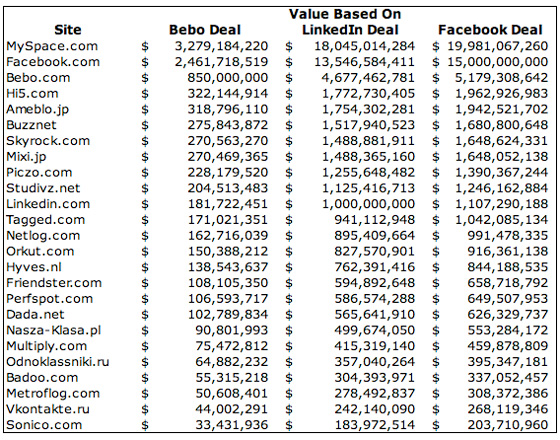
Interestingly, the recent sale of Polish social network Nasza-klasa for $92 million appears to be right in sync with Bebo’s price. The model estimates its value at $91 million based on Bebo’s valuation metrics.
There are some big flaws with the model and analysis in its current state. First, LinkedIn may be in a different class of network, given that all of its users are business focused (no super-poking going on there). As a result, it may be able to monetize users far better than its competitors, no matter what geographic market is being looked at. Still, we’ve decided to leave it in as a data point, with that caveat.
The model itself needs more data. The user numbers are based on April Comscore. We will shortly revise it with the May numbers, although the absolute rankings probably won’t change. More importantly, some big markets are not included yet. The Chinese Internet advertising market, for example, is estimated to be $2 billion in 2008, yet they are not included (mostly because I can’t find data on user numbers for the networks). Also, the Philippines isn’t broken out separately, again due to data availability issues (although the total Internet advertising market in the Philippines is just $3 million this year, so it won’t affect the rankings materially even though Friendster is so strong there). Finally, Russia is currently grouped with “the rest of Europe,” and needs to be separately broken out - it has a large and growing online advertising market and lots of users, so that update may affect the mid-level network rankings.
The advertising spend model is just an estimate and from a single source. I’m less concerned with this data since it doesn’t matter to the model if the estimates are absolutely correct. If the estimates are wrong by different rates in different countries, however, the model will break. If we find better relative data between countries, we’ll update the model with that data. But for now, the PriceWaterhouseCoopers data seems to be pretty good.
Finally, this model doesn’t take into account execution at the company level. Two very similar networks may monetize vastly differently based on methods of advertising and even the brute effort and passion of the employees. This model obviously doesn’t take that into account.
I also note Andrew Chen’s analysis last week which takes a similar approach to this using Google Trends data instead of Comscore. The Google data isn’t granular enough to really dig in to relative values, however, and he was lacking current and deep data on average Internet spend. Still, I agree with his methodology.
As I wrote at the very end of this post, you have to consider the current monetization value of users when comparing social networks. Raw user numbers are pointless without it.
Breaking: Germany’s Plazes Acquired By Nokia
Michael Arrington
34 comments »
 Berlin, Germany based Plazes, a location based social network (and one of the first startups we ever wrote about here on TechCrunch, back in 2005), has been acquired by Finland-based Nokia, the companies are announcing today. The price is not being disclosed.
We most recently wrote about Plazes new iPhone application in May 2008, which will take advantage of the cutting edge location technologies available on the phone (cell triangulation and GPS). The company has raised a total of €3.7 million in venture financing over two round, although the last round was closed in February 2007.
This is the second “mobile social network” in Europe to be acquired in as many months - Danish startup ZYB was acquired by Vodafone in May for €31.5 million.
Co-founder Felix Petersen told me in a hastily scheduled phone call that the company will maintain its Berlin office and all thirteen employees. The Plazes product will become Nokia’s Services & Software unit.
In 2006 Nokia acquired Berlin based Gate5 for a rumored $250 million and turned the product into Nokia Maps, which is deployed in 300 markets. Petersen says the success of that acquisition gave Plazes a lot of comfort in working with Nokia.
As a funny aside, a year ago Petersen was busted by his own product as he avoided one conference to attend another.
Update: by Mike Butcher, TechCrunch UK: My industry sources are telling me that this was a smart acquisition for Nokia, which needed to have a consumer based offering outside the rigid maps infrastructure they have, since the purchase last year of Navteq.
There is also a local story here. The Plazes office is in Berlin, physically close to the Gate 5 people, and we know from good authority that Gate 5 people are highly respected on the Berlin scene. It’s therefore likely that they had a lot to do with the acquisition thinking inside Nokia as they know the guys from Plazes.
From what we know about Nokia, the purchase of Plazes fits in with their strategy in terms of context and location and what to do with it. Put together the Ad system they have, and they control a strong section of the mobile ecosystem from ad generation, delivery through branded channels, with good profile information about the user, especially since most new handsets from Nokia now have GPS built in.
June 22, 2008
CrunchBase: Now With Maps, Advanced Search, Jobs, And Milestones
Henry Work
51 comments »

We’re proud to announce today a slew of new improvements to CrunchBase, our directory for information about the tech startup ecosystem.
Maps
Company and financial organization headquarters are now geocoded and locatable on an interactive map using the Google Maps API.
Say you’re checking out Yelp and want to see just where the company is located and what other startups are nearby. You can click on the [map] link next to Yelp’s address and its headquarters will show up among its 50 closest neighbors, including Kongregate the building over and Slide just a few blocks away.
Furthermore, you can now browse by City, State, Zip Code, or Country. Or choose an arbitrary location and map all of the results within a certain range (e.g., all the startups within 10 miles of Sydney, the 165 companies in Manhattan, or the VCs on Sand Hill Road).
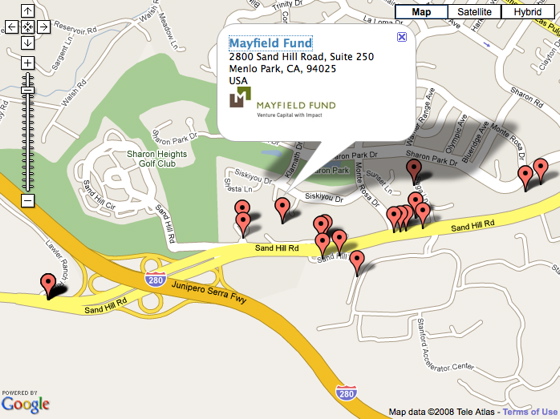
We are also now tracking multiple offices for some of the larger organizations (see Sequoia Capital).
Advanced Search
Our new advanced search capabilities really capitalize on CrunchBase’s structured wiki format. In addition to simple keyword search, users can now search companies, financial organizations, and people by indicating special criteria to which they want results to conform. Now you can, for example, search for all companies founded after 2004 with at least $50 million in funding that have been featured on TechCrunch.

What’s great about structured data is that it’s so easily aggregated. We have lists for all the funding rounds and acquisitions in CrunchBase, each of which is sortable in various ways.
And with advanced search, you can drill down into specific results - even when geography comes into play. For example, you can make a query for all companies within 5 miles of London that have been acquired since 2004. Or all people under the age of 30 who’ve been a part of successfully acquired companies. We’ll continue to improve our search capabilities, so please leave any requests and suggestions in the comments.
Jobs

We’re now showing CrunchBoard job listings on company pages. You’ll now see, for example, that Digg is hiring. With this additional functionality, and our LinkedIn API integration, we hope CrunchBase will become an ever-more important research tool for job seekers.
Milestones
Milestones is our newest and most experimental feature on CrunchBase. It was inspired by our writing team, which receives many press releases with titles like “Service X hits the 1 Million user mark,” or “Company Y hires new CEO.”
While these news items don’t always make TechCrunch’s front page, we wanted a place to highlight them in CrunchBase, so we created a lightweight data type called Milestones. It’s pretty simple: each milestone has a date, description, and source (if available somewhere on the net).
We hope to create a useful timeline of events for every company and product. Here are some of Twitter’s recent milestones:

And as before, CrunchBase is all about community participation. Not only do we add data to the system ourselves, but we encourage everyone else to contribute as well. Notice any missing or incorrect data? Just hit the “Edit This Page” button in the top-right of any profile page and submit your requisite changes. Companies, financial organizations, and people can also be added from the homepage.
Expect to see more community features soon as work to give contributors a greater presence on the site.

No hay comentarios:
Publicar un comentario