CO2Stats Compensates For Your Site’s Pollution
Cameron Christoffers
34 comments »
 Yesterday Y Combinator backed CO2Stats
 announced the launch of a fully functional version of their emissions measuring service for websites. The launch comes nearly a year after the release of a prototype widget that was designed to test the market and gauge user response. The idea eventually attracted enough press and positive feedback for the founders to take their service and calculations to the next level.
CO2Stats makes a website “green” by calculating its environmental footprint and buying green power (i.e. wind, solar) elsewhere on the grid to compensate. The service calculates not only the energy used to power a site’s server, but also the power used by client machines visiting the site. It turns out that visitors actually consume more power than the servers themselves.

The methodology for calculating energy consumption is extremely rigorous, as it must be for something like this to be accepted. The system takes into account geographic location of a site’s servers and visitors, time spent on a site, client device type (mobile, laptap, etc), and even the size of the page window on the user’s screen.
Sites supporting the service sport a clean energy badge that, when clicked on, displays CO2 emissions resulting from visitors, servers, and the network, along with a breakdown of the fuel types used to power the site and where the power was generated.
CO2Stats charges a flat rate that is dependent on the cumulative amount of power they spot their clients. This ensures that sites aren’t punished for peaks in traffic, and makes the idea more attractive to sites with a large userbase. The service could make it big if it becomes standard practice for companies to maintain a “green” web site. Electricity generation required for information and communication techologies is currently responsible for 2% of global CO2 emissions, and this number is only growing. Current clients include Gazelle, and a number of environmental awareness sites.

| Website: | co2stats.com |
| Founded: | 2008 |
CO2Stats aims to help website owners understand the electricity usage and related carbon emissions associated with site usage, and then helps site owners manage their carbon footprint.
The company calculates the greenhouse gas footprint of visits… Learn More

Hello World! AppJet Opens Browser-Based JavaScript School
Jason Kincaid
23 comments »

AppJet, the Y Combinator-funded startup that lets users build web applications from their browsers, has opened a new set of lessons that guide novice users through the basics of programming. The lessons focus on JavaScript, one of the world’s most popular programming languages, and have been written to be accessible to students who have never programmed before.
Co-Founder Aaron Iba says that the lessons will likely take a new programmer a few weeks to work through at a moderate pace, depending on how much time is spent on the interactive demos (each lesson provides a fully functional program that can be modified). There are currently 24 lessons available, with more on the way. After skimming through the first few lessons, I managed to put together a program slightly more complex than “Hello world!”, which you can find here.
This online school is significant because it offers a very low barrier to entry for novices who are looking to get their feet wet and start programming. Nearly every programming tutorial requires some kind of software prerequisite, be it a downloaded client or a server, which can be both expensive and difficult to set up for a new user. Conversely, AppJet requires no software, allowing users to edit, debug, and run code through a browser interface. Because of this low barrier, AppJet may well see an influx of new students who they can convert to regular members.

Besides the lessons launching today, AppJet offers web developers a way to create and host web applications free of charge. The site appeals primarily to users in the long tail, who may not want to spend money on a web server just to host a number of small applications that are only accessed once in a while. Iba says that since its launch in December, AppJet has seen over 1900 applications published, with another 4000 under development (though many of these will likely never be completed).

| Website: | appjet.com |
| Location: | San Francisco, California, United States |
Y Combinator funded AppJet is an online programming tool for building simple web apps. Founded by former MIT students, AppJet intends to simplify the process of writing web applications. The applications are programmed on a web based text editor in… Learn More
Keep It Simple: PhrazIt Offers 30 Character Long Reviews
Jason Kincaid
28 comments »

The web is teeming with user reviews on everything from movies to VC firms. But with so many detailed opinion pieces available, getting to the bottom line can be difficult.
Today sees the launch of PhrazIt, a site looking to cut through the noise by offering users a tag cloud related to various topics on the web. Rather than employing a traditional star or numeric system to rate a topic, PhrazIt uses brief words or phrases no more than 30 characters long.
Once a user has chosen a topic on the site, they’re presented with around 25 tags that have been entered by other visitors. You can either add your own description, or you can click on one of the existing tags (the most popular tags will grow in size, allowing users to summarize a topic quickly).
One of the biggest drawbacks to PhrazIt is that all tags in the cloud are pulled from submissions from the site itself. Instead of searching through popular review sites like Amazon or Rotten Tomatoes, PhrazIt relies on user-submitted data. This works well enough for popular topics (like Batman, seen below), but it makes searches for less common topics a waste of time.
PhrazIt is the first company to launch from the DreamIt Ventures early stage startup incubator, which is similar to Y Combinator. The incubator is currently working with its first “class” of eleven startups, and will have its first exhibition day in early September.
HitMeLater: A Snooze Button For Your Email
Michael Arrington
79 comments »
I complain about my email inbox problems endlessly, and even performed a major purge a couple of days ago that wiped out over 23,000 unread emails. I don’t know what the solution is, but I think it may ultimately involve an admin of some sort despite my stubborn hope for a software solution to make things right.
While I wait for that startup/admin to fix my life, Philip Kaplan (my partner in my second best April Fool’s joke ever) (here’s the first) has built a cool new service that I will likely use in the meantime called HitMeLater.
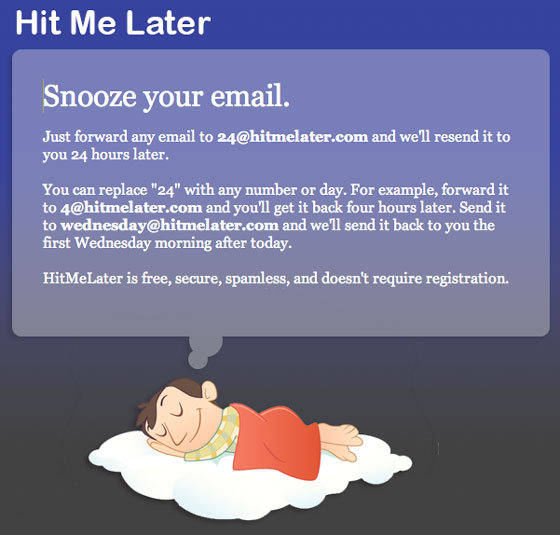
HitMeLater is simple. Forward any email to 24@hitmelater.com and it will send it back to you 24 hours later, putting it on the top of your inbox pile. You can change the number of hours to anything you like, up to 1,000 hours ahead (3@hitmelater.com sends it back three hours later). Alternatively, put in a day (Wednesday@hitmelater sends it back the next Wednesday). If you send it something it doesn’t understand, HitMeLater sends back a polite email message saying “We’re not sure what you want.”
If you’re like me you rely on flags to remember which emails to go back to, but they often get buried and are left unattended. From now on I’ll forward stuff I need to deal with but not immediately to Sunday@hitmelater.com, my slowest email day.
August 13, 2008
Twitter Ends SMS Support In UK; Says Costs Up To $1,000/user/year
Michael Arrington
61 comments »
Twitter says they’ve stopped sending SMS updates to Twitter users in the UK because of the high cost of sending those messages. US, Canada and Indian users can still opt to receive messages via SMS.
Twitter says that a single user, capped at 250 received SMS messages per week still costs them $1,000 per year in SMS fees. They don’t have that problem in the US and some other countries because they’ve been able to negotiate service fees that max out after a certain point.
“We’ve arrived at a point where the responsible thing to do is slow our costs and take a different approach” they said in the blog post.
Next up: a revenue model.
UPDATE: See TechCrunch UK for more UK reactions to this move - it’s not pretty…
AppStore Developer TapTapTap Publishes Sales Figures
Nik Cubrilovic
30 comments »

iPhone application development house taptaptap has published sales figures for the first month of sales for their two AppStore applications, bringing further insight into overall sales volume and figures for the online store. The two applications developed by the company are WhereTo, an application that provides a more general GPS interface to the iPhone with location-based services, and Tipulator, a simple tip calculator.
WhereTo retails for $2.99 in the store and 24,094 copies were sold in the first month - netting the company just over $50,000 in revenue after Apple took their cut (it currently ranks #69 on the top paid application list). Tipulator retails for 99 cents, and sold 3,168 copies which resulted in just over $2,200 of revenue (it is currently unranked). The table below outlines overall sales volumes and revenues for each application:
taptaptap AppStore sales and revenue numbers for US sales, month 1
| WhereTo | TipCalculator | |
| URL | AppStore | AppStore |
| Price | $2.99 | $0.99 |
| Number Sold | 24,094 | 3,168 |
| Gross Sales | $72,041.06 | $3,136.32 |
| Net Sales (after AppStore cut) | $50,597.40 | $2,217.60 |
| Total Gross | $75,177.38 | |
| Total Net | $52,815 |
The resulting net profit and sales figures are good for a small company that has developed one application that is relatively sophisticated, and another that is very straight forward and simple but yet still brings in $2,000 a month. There is definitely great revenue potential for developers of iPhone applications, as users of the AppStore and the iPhone in general are more likely to pay for applications. Integrating with iTunes makes the process simple for the user, but for the developer poses a challenge as all applications must be submitted to Apple and must meet their approval.
We should also note that while both of these applications have done well, their download figures unsurprisingly pale in comparison to those of Facebook and Tap Tap Revenge, both of which have over 1 million users. The real money in the App Store may well lie in monetizing these free applications, be it through integrated advertising or downloadable content (though it remains to be seen what restrictions Apple will place on this kind of strategy).

No hay comentarios:
Publicar un comentario